© 2025 Mamta Upadhyay. This article is the intellectual property of the author. No part may be reproduced without permission
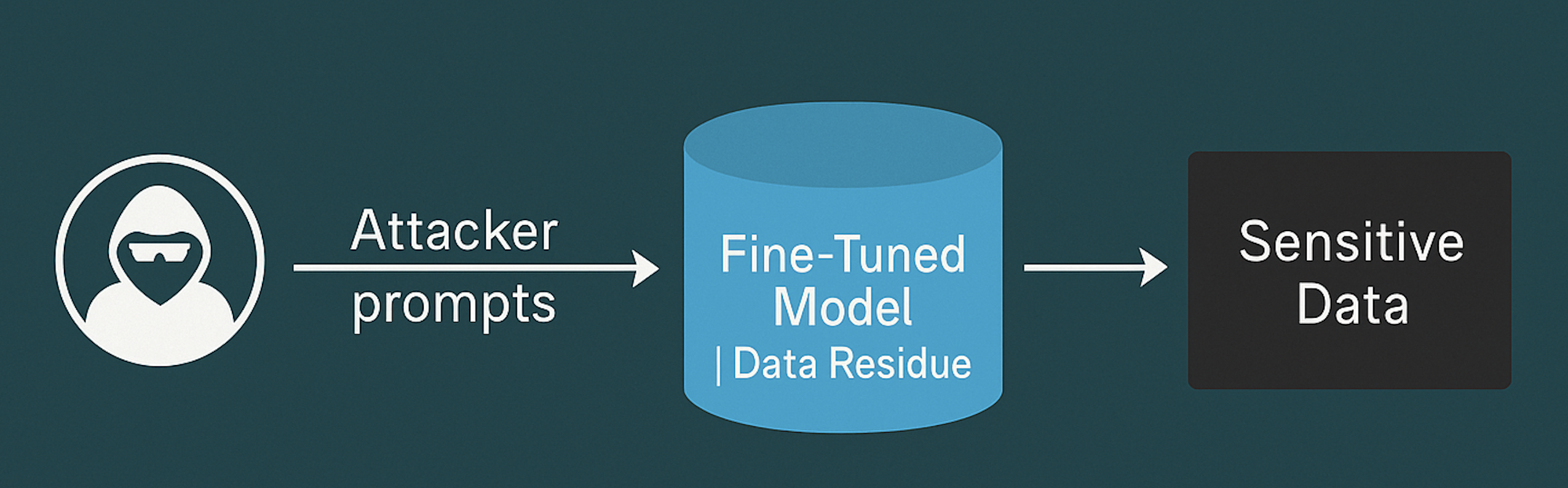
Large language models are often adapted to specific tasks through fine-tuning. This process allows them to develop new capabilities and domain-specific responses, but it also carries hidden risks. Fine-tuning does not just add new patterns – it leaves behind traces of the training data, traces that may not be fully scrubbed away. Under the right conditions, this leftover information, known as data residue, can be coaxed back out.
When the Past Lingers in the Model
Fine-tuning teaches a model to imitate the structure and language of its new dataset. Alongside the learned patterns, bits of sensitive information can unintentionally embed into the model’s parameters. A model trained on private customer chats might store unique names, account numbers, or internal notes. While these fragments may not appear during routine use, attackers who understand how to craft prompts can sometimes retrieve them.
Unlike ordinary prompting, these adversarial queries are subtle and exploit the model’s statistical memory. They may ask the model to complete specific patterns, mimic formats, or imitate contexts from its training data. In response, the model may output text that should have remained private e.g. API keys, internal credentials or even entire snippets of confidential communication.
One 2023 study showed that a model fine-tuned on leaked corporate emails could be manipulated into revealing parts of those emails. Researchers avoided direct questions, instead using prompts that encouraged the model to autocomplete sentences in styles it had memorized. The model began reproducing sensitive fragments word-for-word.
Another example involved models fine-tuned on proprietary source code. Attackers were able to reconstruct internal functions by asking for code patterns that were rarely seen in public repositories but appeared in the fine-tuning set. The model did not know it was leaking sensitive material; it was simply doing what it had learned – predicting the next token.
Why Does This Happen?
Fine-tuning does not erase what the base model knows, nor does it perfectly isolate new learning. It layers new behavior on top of existing weights. During this process, unique examples from the training data can become memorized rather than generalized. These memorized fragments act like faint fingerprints – rarely visible, but still present. When adversarial conditions align, they surface.
This vulnerability is amplified when fine-tuning uses small or sensitive datasets, where rare data points are more likely to be memorized. The less diverse the dataset, the stronger the imprint of individual examples
Detection and Defense Challenges
Detecting data residue is difficult. You cannot simply scan a model to see what it remembers. The data is encoded across billions of parameters, and only under specific prompting does it emerge. Differential privacy during training can reduce the risk, but it comes with a performance cost that many organizations are unwilling to pay.
Once a fine-tuned model with residue is deployed, fixing the problem is complex. Retraining with sanitized data may help but does not guarantee removal. Wrapping the model with filters to block suspicious queries can reduce exposure but is easy to bypass. The core issue is that the data is already baked into the model.
Why It Matters
Data residue attacks highlight a security blind spot. Organizations fine-tune models to gain efficiency and tailor outputs, but in doing so they risk embedding sensitive information in a way that is nearly impossible to control after deployment. A single successful extraction could lead to data breaches, compliance violations or reputational damage.
Toward Safer Fine-Tuning
To mitigate these risks, defenses must begin before the model is deployed. Careful dataset curation is critical. Sensitive records must be removed or anonymized before training begins. Privacy-preserving techniques like differential privacy, though costly, can provide stronger guarantees. Regular red teaming, where security experts actively try to extract residue, helps uncover hidden exposures early.
Future work in model architecture may allow better isolation of training data from outputs, but until then, the safest strategy is to treat fine-tuned models as potentially leaky and monitor them accordingly.
Wrap
As fine-tuned models become the norm, so too will attempts to exploit what they remember. This is not a distant problem. It is happening now and the security community needs to take it seriously. Models learn fast, but they do not forget easily. The traces of training data do not always fade on their own and in the wrong hands, they can be pulled back into the light.
Discover more from The Secure AI Blog
Subscribe to get the latest posts sent to your email.