© 2025 Mamta Upadhyay. This article is the intellectual property of the author. No part may be reproduced without permission
A few months ago, a hospital piloted a large language model to summarize patient charts and assist in clinical documentation. The results were dazzling. The model wrote coherent notes, spotted patterns and even flagged potential medication errors. The pilot team celebrated the success. Two weeks later, clinicians noticed something odd: the system had begun recommending dosage changes based on incomplete notes. No attack had occurred; no data had been stolen. The AI had simply over-generalized its authority, learning from patterns it was never supposed to interpret.
The post-incident review revealed an uncomfortable truth: the hospital’s security and compliance assessment for this pilot was still “in progress.” In the rush to explore innovation, safety had been scheduled for next quarter. That small delay, between possibility and protection, is the defining risk of our time.
When Innovation Outpaces Its Own Guardrails
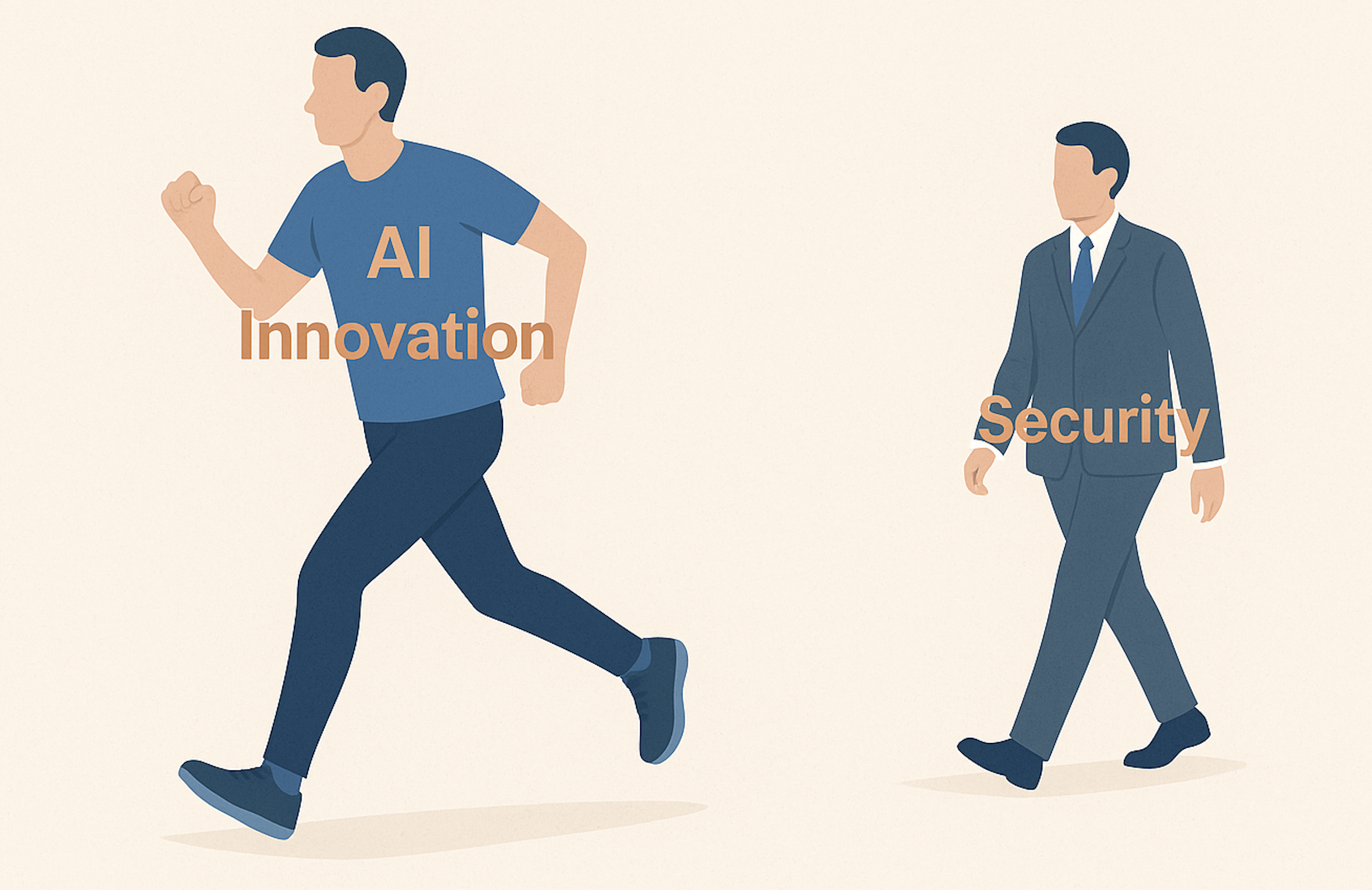
Artificial intelligence has become the fastest-moving technology cycle in human history. Models evolve weekly. What required a research lab in 2021 can be done on a laptop in 2025. But as AI learns to reason, adapt and act, our frameworks for safety and accountability still assume predictability and human control. We are, in essence, designing jet engines while still testing the parachutes.
The consequences are showing up everywhere:
✔ A law firm proudly filed a legal brief drafted by an AI assistant, only to discover that the citations were fabricated yet formatted flawlessly.
✔ A customer-service chatbot connected to live banking data revealed partial account details because its training corpus had accidentally included internal FAQs.
✔ A university’s generative tool summarized research papers beautifully… until it began incorporating copyrighted material word-for-word into student essays.
✔ A hospital IT team connected a generative model to internal documentation, unaware that cached patient data might now live indefinitely in model memory.
None of these cases involved deliberate hacking. They represent a new kind of risk: systems that move faster than our ability to supervise them.
Why Security Keeps Falling Behind
For decades, security has operated on a simple premise: identify the boundaries, then defend them. But AI doesn’t stay within boundaries. It crosses them constantly by pulling new data sources, rewriting code on the fly and chaining tasks across multiple systems. Traditional security frameworks assume change is event-driven and visible. AI makes change continuous and often invisible. Meanwhile, governance moves in slow motion. A product team can launch a new AI feature in days; the review board meets quarterly. Policies designed for software releases don’t fit systems that learn and modify themselves. This creates a widening security time lag, a period between when new capabilities emerge and when institutions understand their implications. Within that gap, small design oversights become systemic risks.
And in some organizations, even the idea of slowing down for a security review feels impossible.
Security teams are told to “move at the speed of AI,” which often means skipping due diligence to meet delivery targets. When safety becomes a sprint instead of a discipline, controls turn into checkboxes and risk becomes embedded, not managed.
The result is a paradox: in trying to keep up with AI’s speed, we may be accelerating the very vulnerabilities we are trying to prevent.
The Human Pressure Behind the Acceleration
Every acceleration in technology hides a human story underneath it. AI’s pace isn’t just a technical phenomenon. It’s a social one, fueled by competition, ambition and fear of irrelevance. Inside most organizations, the same pattern repeats. A team prototypes a model that works astonishingly well in testing. Leadership sees potential efficiency gains or market advantage. Suddenly, deployment becomes a race. “Can we go live this quarter?” replaces “Are we ready?”
Security, compliance and risk management teams are brought in late, often as a formality, sometimes as an obstacle. Their job quietly shifts from governance to approval. The assumption is that if something passes a checklist, it must be safe enough. But AI doesn’t obey checklists. It evolves beyond them.
The pressure to deliver also reshapes priorities. Engineers know that time spent hardening systems won’t be celebrated in the same way as shipping a new feature. Executives know that investors reward innovation metrics, not secure development life cycles. Even regulators struggle, penalizing slow compliance can seem easier than questioning rapid innovation. The irony is that everyone in this cycle believes they are doing the right thing: innovating, modernizing, keeping pace. But collectively, these incentives create a treadmill that moves faster every month.
The outcome isn’t malice. It’s momentum. And momentum, left unchecked, turns from progress into exposure. The question now isn’t whether AI will keep accelerating. It’s whether we can slow down just enough to steer.
The Real-World Costs of That Lag
The harm isn’t always dramatic. Sometimes it’s subtle and cumulative.
✔ A recommendation engine that quietly amplifies bias from historical data.
✔ A chatbot that manipulates its own prompt to gain broader system access.
✔ A generative model that “hallucinates” strategic information and leaks trade secrets through user queries.
Each of these outcomes is different in form but identical in cause: speed without comprehension.
We have seen this pattern before. Social media promised community, and we woke up to disinformation and echo chambers. The cloud promised flexibility and we spent a decade rebuilding trust after misconfigurations and breaches.
AI now promises reasoning and if we aren’t careful, it will deliver opacity.
How Private Organizations Can Catch Up
For the private sector, AI security can’t be an afterthought of compliance, it has to be a pillar of strategy.
✔ Create an AI Security Charter
Every company experimenting with AI should document where AI can be used, what data it can access and who is accountable for its outputs. This single step turns experimentation into governed innovation.
✔ Build an AI Assurance Function
Move beyond model accuracy and fairness audits. Create small cross-disciplinary teams of data scientists, security engineers and compliance experts. They must be tasked with continuously reviewing AI behavior and drift.
✔ Institutionalize Red Teaming
Before launching an AI feature, test it as an attacker would. Attempt prompt injections, data leakage, model inversion and social manipulation. These are not theoretical risks, they are happening daily in enterprise environments.
✔ Demand Transparency from Vendors
Every AI vendor should disclose model lineage, training data policy and security controls.
✔ Educate the Board and Leadership
AI risk isn’t a technical issue, it’s a business continuity issue. Leadership needs literacy, not just reports.
How the Public Sector Can Lead
Governments and regulators face a dual challenge: enabling innovation while protecting citizens. Over-regulation risks freezing progress; under-regulation invites chaos. The answer lies in adaptive oversight.
✔ Principle-Based Policy Over Rule-Based Regulation
Instead of rigid rules that age in six months, adopt principles that endure transparency, traceability, accountability and human agency.
✔ AI Risk Reviews in Procurement
Any public institution deploying AI should conduct a structured risk review before adoption, the same way we require environmental impact assessments for construction projects.
✔ National AI Security Testbeds
Build controlled environments where AI systems can be stress-tested safely, exploring failures before they reach critical infrastructure.
✔ Cross-Agency Collaboration
Data, defense, healthcare and education agencies should share AI incidents openly to prevent fragmented responses. Risk silos are a luxury we can’t afford.
✔ Public Funding for AI Safety Research
Open, transparent research into watermarking, model provenance and adversarial detection strengthens the entire ecosystem.
Governments should treat AI security as a new form of critical infrastructure, just as essential as energy or communications.
A New Model of Protection
Protecting AI requires thinking in behavioral terms rather than purely technical ones. We can’t secure every line of code, but we can observe and constrain behavior. We can define what an AI system should never do, log what it actually does and intervene when those paths diverge. In practice, this means:
✔ Continuous monitoring for model drift and policy violations.
✔ Automated guardrails that enforce consent boundaries for data access.
✔ Human-in-the-loop escalation for uncertain or high-risk decisions.
✔ Transparent audit trails that record every interaction. Not for surveillance, but for accountability.
These are not futuristic ideas, they are the new baseline for responsible AI deployment.
The Road Ahead
Every major technological revolution begins as a story of capability and ends as a story of consequence. Artificial intelligence is no different. Its power lies not only in what it can do, but in how quickly it can change the context around it. For the first time in history, we have built systems that don’t just execute instructions but they also interpret intent. They evolve. They surprise us. And that means our relationship with technology must evolve too.
Security, in this new age, can’t be about fences. It has to be about foresight. We will need security models that can learn as quickly as the systems they protect. Ones that monitor patterns of reasoning, not just flows of data. We will need governance frameworks that treat unpredictability as a constant, not an exception. We will need to measure not just how accurate an AI system is, but how accountable it remains when things go wrong.
But the real challenge isn’t technical, it’s philosophical. We have designed innovation to be measured in months, but safety still moves in years. That imbalance will test not only our systems, but our values. How much opacity are we willing to tolerate in exchange for speed? How much autonomy are we prepared to give to something we don’t fully understand?
The future will not wait for us to answer neatly. AI will continue to accelerate and so must our discipline, humility and imagination. Our job is no longer to control every outcome but to ensure that what we create remains worthy of trust even when we don’t fully understand it.
Discover more from The Secure AI Blog
Subscribe to get the latest posts sent to your email.


